Short answer: no. Longer answer: it genuinely doesn’t matter as much as you think… and here’s why that’s actually good news.
The question comes up constantly.
In travel forums, in DMs to our surf coaches, in the quiet deliberation of someone who’s been tempted by a week in Morocco but isn’t sure their body is ready for it. And almost always, the person asking is fitter than they give themselves credit for.
A surf and yoga retreat isn’t a fitness test.
It’s not a boot camp, a competition or an environment where anyone is measuring your output.
It’s a week of movement, ocean, good food and the kind of deep reset a gym membership has never (and will never, if you ask us) managed to provide.
People arrive from every conceivable starting point. Office workers who haven’t exercised in months, runners who’ve never been near a surfboard, experienced yogis who can’t swim. And they all have a good time.
Because the experience is designed that way. It’s how it all works.
What a surf and yoga retreat actually asks of you
It’s worth being honest about what the week physically involves.
Surfing is physical: Paddling uses muscles most people don’t train. Standing up on a moving board is awkward at first. You’ll fall off repeatedly, which requires getting back up. Sessions run a couple of hours and by day three most beginners notice muscles they didn’t know existed!
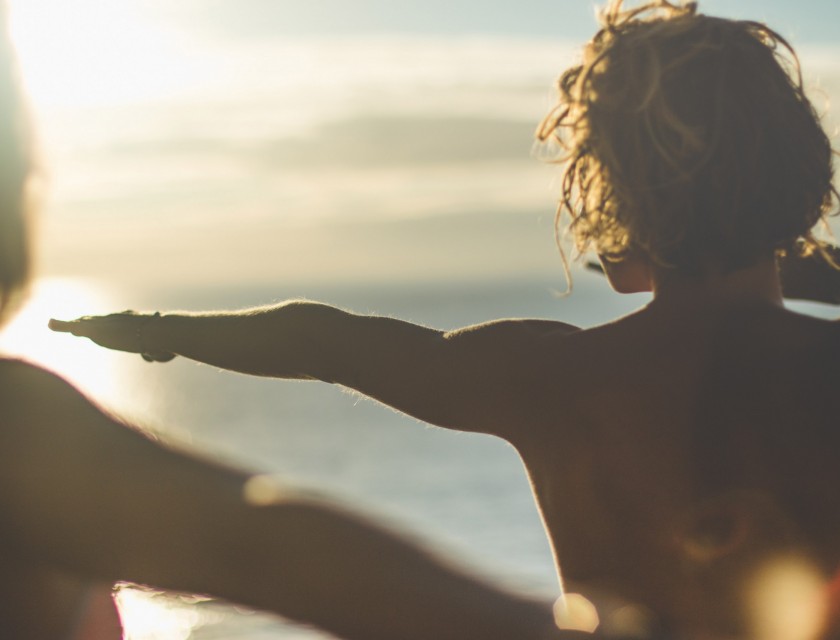
Yoga is whatever the teacher makes it: At Surf Maroc’s Villa Mandala, the Yoga Surf Retreat runs 90-minute sessions twice daily… dynamic, intentionally-themed flows in the morning, restorative yin-based practice to soothe in the evening. Both are adapted to all levels. A complete beginner and a seasoned practitioner are in the same room and both get what they need from it.
So what does the week actually require? Roughly this:
- The ability to lie face down and push yourself up (the pop-up that gets you standing on the board)
- Enough stamina to paddle in short bursts, rest and paddle again
- Willingness to be a beginner in public (a mental challenge more than a physical one… trust us!)
- The capacity to enjoy yourself between the hard bits
That’s a pretty accessible list. And every item on it improves quickly once you’re in the water OR on the mat.
The fitness myth and where it comes from
Watching someone paddle confidently into a wave and spring to their feet looks athletic. And it is, eventually. But beginner surfing looks quite different.
You’re in shallow, forgiving whitewater. Your board is large, wide and stable. Your instructor is in the water with you, coaching every movement.
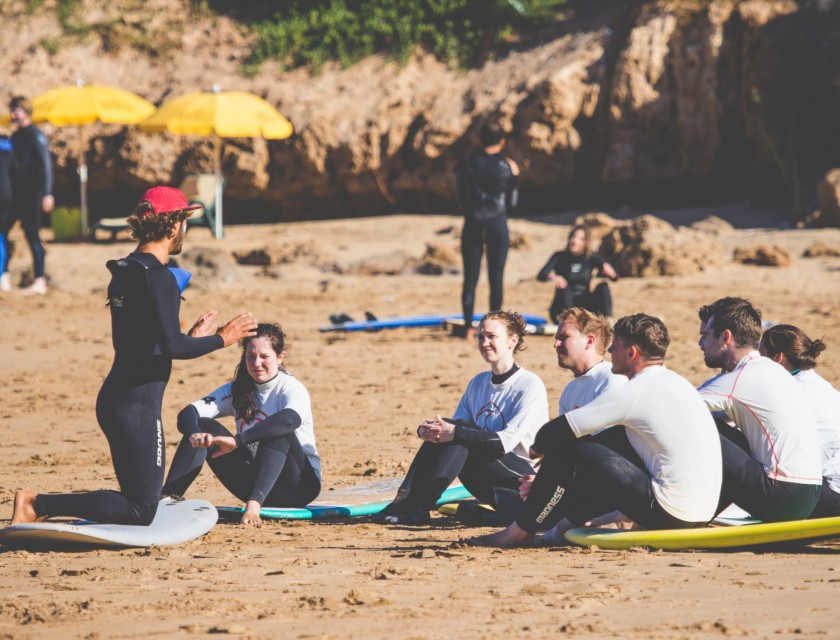
The surf coaching system at Surf Maroc is built around levels too. This means you’re never placed in conditions beyond your ability.
Level one starts on the beach, moves to waist-deep water and focuses on the basics: board handling, paddling, reading the water and catching broken waves.
You progress when you’re ready, not on anyone else’s schedule.
The yoga piece follows the same logic.
Modifications exist for every pose. Props are there to be used. Nobody in a well-run retreat room is looking at anyone else’s downward dog.
What the retreat does for your body that preparation can’t
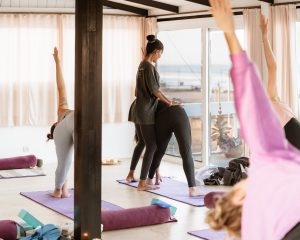
Here’s what the fitness question misses: a week of daily surf and yoga does more for your surf fitness than months of preparing for it at home.
Paddling builds paddling fitness.
Pop-ups build pop-up muscle memory.
Yoga opens the hips and shoulders that surfing tightens and accelerates recovery between sessions so you show up fresh the next morning.
This is the hidden value of a surf and yoga retreat over a standard surf camp or surf experience provider. The yoga isn’t decorative. It’s functional recovery built into the schedule.
When your shoulders are loose and your hips are open, you paddle better. When your nervous system is calm, you read waves better. The two disciplines reinforce each other in ways that become obvious by day three.
The Moroccan coastline helps too.
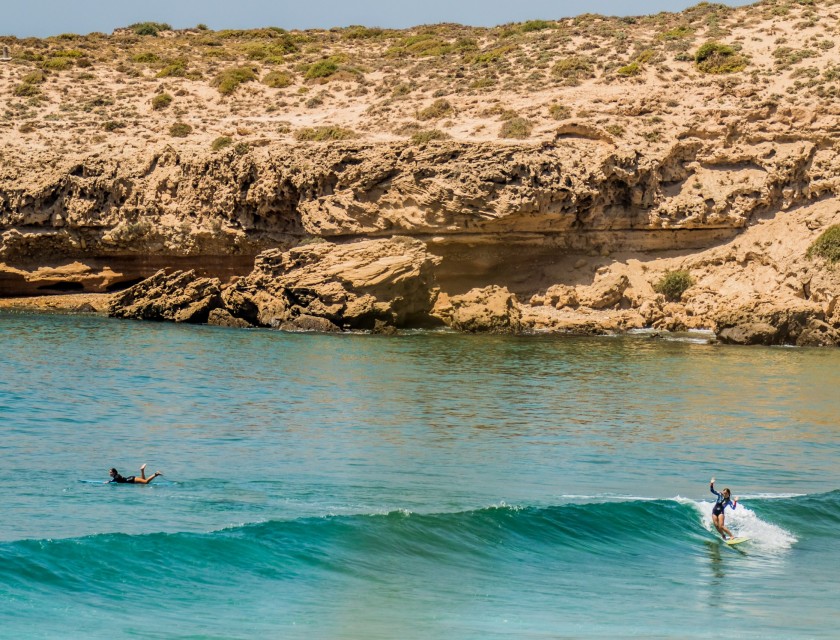
Taghazout has an unusually diverse range of breaks, which means there’s almost always somewhere sheltered and manageable regardless of conditions.
Our guide to surfing Morocco and Taghazout covers this in depth. But the short version is that the region is one of the best places in the world to learn, partly because you’re never short of options.
Here’s what’s actually worth doing if you want to prepare
Nothing is required. But if you like to show up having done something, a few weeks of simple prep make a noticeable difference:
- Pushups (even modified on your knees) build the upper body strength that makes pop-ups easier and less exhausting
- Hip and shoulder stretches like pigeon pose, thread the needle and cross-body shoulder stretches target the areas surfing demands most
- Swimming, if you have pool access, builds paddling endurance in a way almost nothing else does
- Any activity that gets you breathing hard (like walking, cycling, light jogging, watching a crime series on Netflix… jokes) improves the cardiovascular base that keeps you in the water longer
- Want to feel fully prepped before you arrive? Head to our YouTube channel for surf-focused yoga routines and mobility sessions, all filmed at Amouage.
Two short sessions a week for a month is plenty.
The goal isn’t transformation. It’s arriving with enough baseline energy to enjoy the first couple of days rather than spending them horizontal.
For practical first-timer tips on food, conditions and what to pack, Surf Maroc’s Morocco guide is an essential read before you go.
The honest caveat
Most people are fine. A small number of situations are worth thinking through before booking:
- Shoulder injuries: Especially those that limit overhead movement. Paddling will be uncomfortable, worth flagging to the team in advance
- Heart conditions or recent surgery: Check with your doctor before committing to physically active days
A good retreat operator will talk through any concerns before you book. Not after.
The short version
You don’t need to be fit. You need to be willing.
Our retreats and camps provide the structure, the right waves for your level, qualified coaching and a yoga practice that keeps your body functional throughout the week.
What you bring is curiosity and the readiness to be a beginner for a while.
After twenty years of welcoming guests to the Moroccan coast, Surf Maroc has seen every version of “I’m not sure I’m ready” walk through the door. They all get in the water. Most are disappointed when the week ends.
The only fitness requirement, really, is showing up.
Curious about what a week actually looks like? Explore the Yoga Surf Retreat at Villa Mandala and see if it’s the right fit for you.

Frequently asked questions
- Do I need to be fit to go on a surf and yoga retreat?
No. A basic level of general health is enough. Sessions are adapted to your level, rest is built into the schedule, and the week is designed to build your fitness rather than require it upfront.
- Can I do a surf retreat if I’ve never surfed before?
Absolutely. Most guests at beginner-focused retreats have never surfed. Instruction starts from scratch on the beach, in shallow water, with equipment chosen for learning rather than performance.
- What if I’m not flexible enough for yoga?
Inflexibility may be a starting point, but not a barrier. Classes are adapted to all levels, props and modifications are standard and most guests finish the week with noticeably more range of motion than they started with.
- Is a surf retreat suitable if I’m older or returning after a long break from exercise?
Yes, with honest self-assessment. If you can move comfortably, get up from the floor and sustain light activity for a couple of hours, you’re a candidate. Many guests are in their forties, fifties and beyond.
- What if I’m a stronger yogi than surfer, or the other way around?
Both are very common. The two parts of the programme are independent enough that excelling at one and struggling with the other is completely normal. Instructors work with where you are.
- Will I hold the group back if I’m less fit?
No. Groups are split by level, not by speed. Someone learning to stand up in whitewater and someone working on their turns are on different parts of the beach with different instructors.
- What should I do to prepare?
Nothing is mandatory. If you want to prep: pushups, hip and shoulder stretching and light cardio for a few weeks. More useful than any of it… good sleep in the week before you arrive.
- Is Morocco suitable for complete beginners?
Very much so. The Taghazout coastline has a huge variety of breaks including gentle, sandy-bottomed spots specifically suited to learning. Pleasant water (even in winter), consistent conditions and year-round sun make it one of the most welcoming places in the world to start surfing.
One last thought
There’s a particular kind of person who spends six months thinking about booking a surf retreat and three days actually on one, wishing they’d booked sooner.
Newsflash… hesitation is almost never about logistics!
It’s about whether they’re ready. Fit enough, flexible enough, young enough, experienced enough. The answer, almost universally, is yes.
The ocean isn’t selective. It’ll take whoever shows up, give them a proper working over and send them home changed.
The question was never whether you’re fit enough for the retreat. It was always whether the retreat was right for you.
And if you’re still reading this, it probably is.
What are you waiting for?