
So you’ve booked your surf trip to Morocco.
Maybe you’ve been eyeing those Taghazout lineups on Instagram for months or a mate convinced you over a beer that catching waves in the refreshing Atlantic water is the best thing you’ll ever do.
Either way, you’re in.
But now the panic takes hold: should you be training? Are your arms strong enough? Do you need to get a six-pack by Tuesday?
Breathe.
Here’s the honest guide.
The trap most first-timers fall into
About six weeks before a surf trip, a lot of beginners make the same mistake: they go absolutely feral in the gym.
Suddenly, it’s daily sessions, heavy weights, running programmes they found at midnight and YouTube tutorials on Bulgarian split squats.
Noble effort. Wrong approach.
Overdoing it before a surf holiday is one of the most reliable ways to arrive exhausted, stiff, or nursing a tweaked shoulder.
Surfing engages the entire body in ways most gym routines simply don’t replicate. The good news?
Effective surf fitness training doesn’t require a complex programme or expensive equipment.
A handful of well-chosen bodyweight exercises done consistently will serve you far better than any crash course in surf training workouts.
You just need to move a bit smarter.
What surfing actually asks of your body
Before building any exercise routine, it helps to understand what you’re actually preparing for.
Three things drive everything for first-timers.
- Paddling endurance. Paddling can occupy up to 90% of a surf session, which surprises most beginners. It calls on your back muscles, shoulder girdle and core strength simultaneously
- Pop-ups. A fast, coordinated push from a pushup position into a standing position… feet shoulder width apart, front knee bent, torso straight, front foot forward. It’s equal parts upper body strength, hip mobility and muscle memory
- Balance and body position. Surfing is almost entirely unilateral. One foot forward, one back, weight shifting constantly between them. This requires less raw athletic ability and more the kind of deep stability that comes from training on an unpredictable surface
What’s actually worth doing before you go
1. Paddling prep: arms, shoulders and back
Push-ups are the cornerstone of any surf workout for good reason.
They strengthen the upper body, align the spine, and stabilise the core, which makes pop-ups and duck dives significantly easier.
For ring pushups, loop a towel through a door handle or use gym rings: the instability fires up the shoulder stabilisers even more effectively than standard pushups.
Either way, from your starting position lower slowly, then explosively push back up. A few clean reps beat twenty sloppy ones.
If you have pool access, swimming front crawl/freestyle is excellent cross-training, targeting the same muscle groups as paddling and building the cardiovascular endurance that keeps you in the water longer.
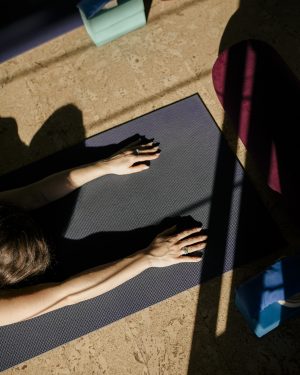
No pool? Prone paddling simulation works fine. Lie face down on a mat, one arm extended forward, free hand flat by your hip and alternate the paddle stroke. The key cues:
- Pull your shoulder blades together and down on each stroke
- Keep your chin just above the mat, neck long
- Drive from the lats, not just the arms
Want to make sure you’re as ready as can be? Check out our Youtube channel where we have heaps of surf and general yoga routines… all performed at Amouage.
2. Core strength: the foundation of everything
A strong core isn’t about having a surfer’s physique. It’s functional.
Your core stabilises the body on the board and transmits power through every dynamic movement. It’s what separates surfers who look comfortable on a wave from those who look like they’re hanging on for dear life.
- The key is integration rather than isolation. Standard crunches won’t cut it.
- Single foot planks introduce instability and engage far more of the core than a flat plank
- Rolling a swiss ball forward from a kneeling position (arms extended and ball forward until your body is fully extended, then pulling back to the starting position) is a deceptively brutal exercise that mirrors exactly what your trunk needs to do on a moving board
3. Mobility: the thing everyone skips
Tight hips and stiff shoulders will limit your surfing performance more than weak arms.
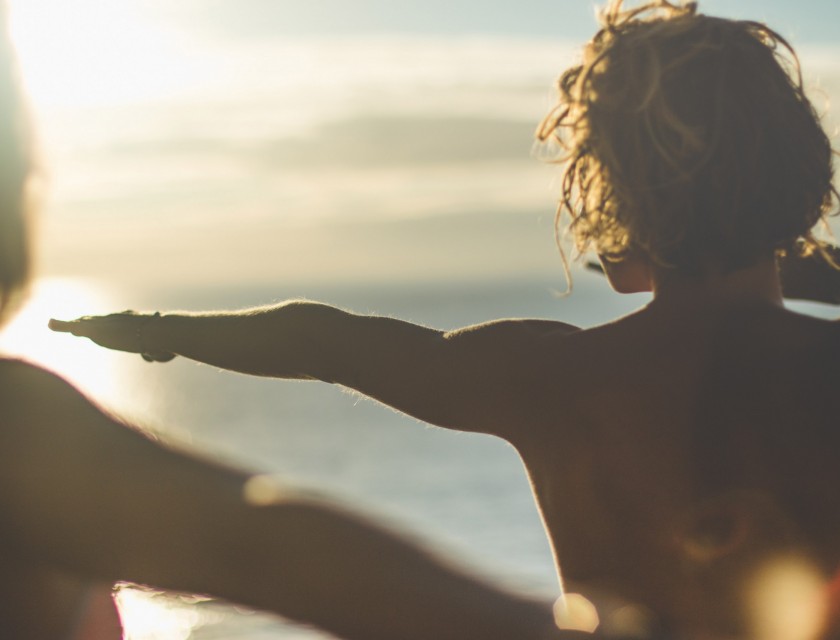
Yoga movements like low lunges, pigeon pose, and hip circles directly mirror what your body needs on a board: front knee tracking over front foot, torso upright, arms free to move.
A consistent mobility routine also counteracts the tightness that surfing itself builds over time, making it useful before the trip and throughout it.
If you want to go deeper on the yoga side, it’s worth reading about the specific benefits of yoga for surfing.
Even ten minutes morning and evening in the week before you leave makes a noticeable difference.
Keep it gentle. The goal is to arrive supple, not depleted.
4. Balance training: underrated, undersold
Indo board exercises are genuinely effective here and more engaging than basic squats.
The unstable surface forces the legs and core to work continuously, building the leg muscle endurance and the micro-adjustment reflexes that riding a wave demands.
If you have access to a balance board, run through basic squats, single-leg holds and small dynamic movements.
- Step forward onto one leg and hold
- Return to the starting position
- Repeat on the opposite leg
- Ten minutes a day in the living room counts more than you’d think
- You can also watch our balance guru, Shannon, go through a pre-surf warm-up
5. Fuel it properly
Training and surfing both fall apart without decent nutrition.
Surf sessions can run to three or four hours and the combination of physical effort, salt water, and sun is surprisingly draining.
A balanced diet that keeps energy levels stable throughout the day supports both surfing performance in the water and recovery afterwards, so you can show up again the next morning and do it all over again.
If you’re heading to Morocco, this part largely takes care of itself… the food culture is built around fresh, nourishing ingredients and eating well in Taghazout is genuinely one of the pleasures of the trip.
What not to do in the two weeks before you leave
Just as important as what to do is what to avoid. Three things to leave out of your pre-trip routine:
- Don’t start a new heavy strength programme. Kettlebell swings, weighted vest work and high-volume interval training are all great in normal life but risky if your body isn’t yet adapted to them
- Don’t neglect sleep and recovery. Fitness level matters less than being well-rested. Sleep is when your body repairs, adapts and prepares
- Don’t skip mobility in favour of more reps. A few reps of a well-executed movement beats a long workout routine done stiffly
Here’s the secret to real surf fitness
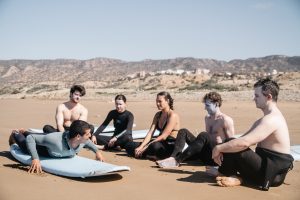
The most effective surf training is surfing.
Once you’re in the water consistently (with good instruction might we add), your body figures out what it needs remarkably quickly.
Paddling builds paddling fitness. Catching waves trains the pop-up. More waves mean more reps of every movement pattern you’ve been preparing.
This is precisely why a structured surf trip, particularly somewhere like Taghazout with Surf Maroc, is so effective for beginners.
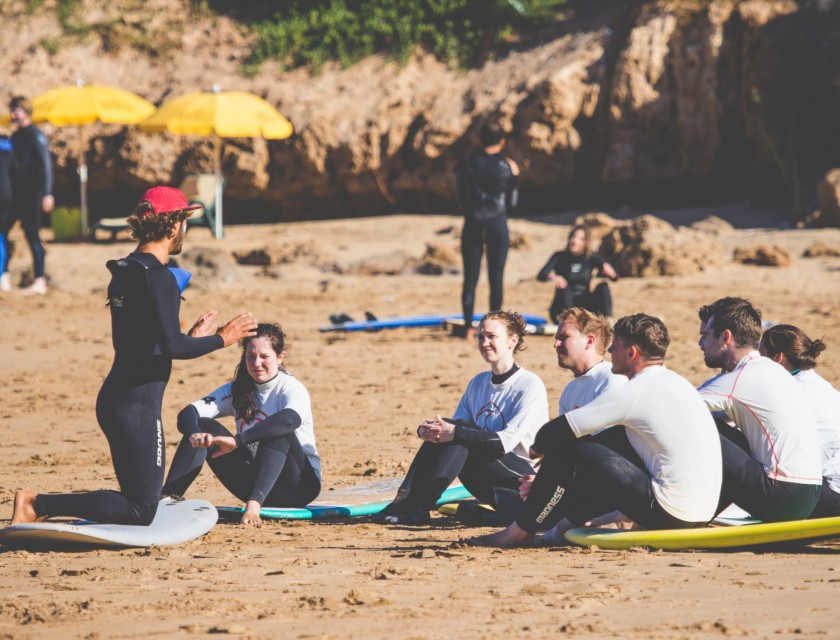
Surf Maroc’s coaching programme matches you to waves suited to your level from day one, with qualified instructors watching your paddle, your pop-up and your body position in real time.
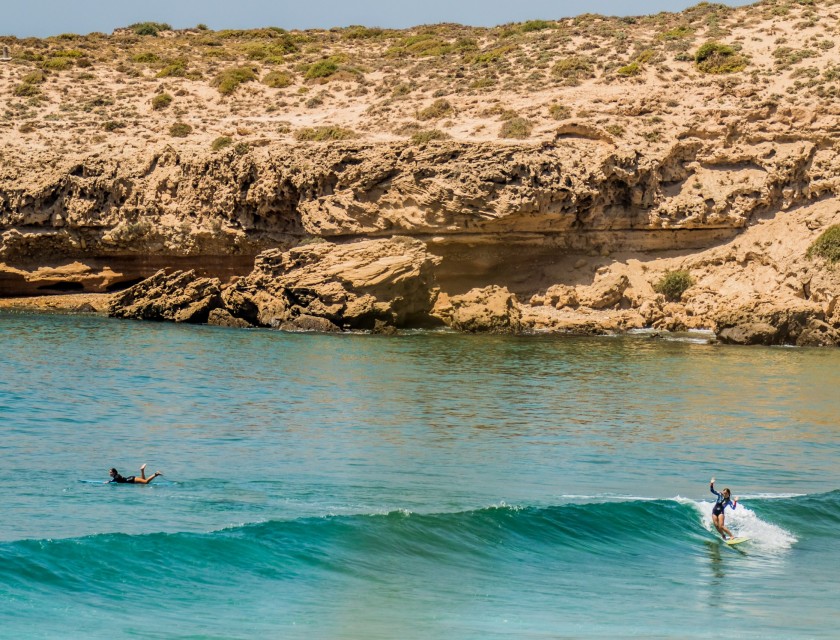
The conditions in Taghazout, with consistent waves and a forgiving learning environment, mean you can focus on surfing rather than surviving.
The surf fitness takes care of itself.
The short version
The pre-trip checklist, stripped back:
- Paddling drills and pushups for the upper body
- Integrated core work over isolated crunches
- Daily hip and shoulder mobility
- Balance board or single-leg work for stability
- A proper warm-up before every session
- Eat well, sleep more, skip the ego lifts
Arrive rested and ready to spend as much time in the water as possible, because that’s where the real progress happens. Morocco will do the rest.
Ready to improve your surfing in one of the world’s best beginner-friendly lineups? Explore Surf Maroc’s accommodations in Taghazout
Frequently asked questions
What exercises do surfers do?
Pushups, burpees, plank variations, single-leg balance work, and hip and shoulder mobility drills. Plus as much time in the water as possible, because nothing replicates surfing quite like surfing.
Is surfing good for bone density?
Yes. It’s a weight-bearing activity that loads the shoulders, spine, and legs. It won’t replace targeted strength training, but it contributes more than most people expect.
Is 2 hours of surfing good exercise?
Very much so. Paddling alone can account for up to 90% of a session. Add pop-ups, duck dives, and the constant balancing act, and two hours in the water is a serious whole-body workout.
Is surfing good for losing weight?
It can be. Surfing combines cardio with strength and balance demands, and burns a solid number of calories. The bigger factor is that people actually enjoy it, so they keep doing it.
Can you get fit from surfing?
Absolutely. Regular surfing builds upper body strength, core stability, and functional mobility. A week of daily sessions in Taghazout often does more than months of inconsistent gym visits.
Why do surfers look so healthy?
They’re outdoors, active, eating to fuel performance, and sleeping well. Surfing builds balanced, functional fitness: strong shoulders, a strong core, lean legs, good posture. The lifestyle tends to do the rest.
How to train your body for surfing?
Focus on paddling drills, integrated core work, hip and shoulder mobility and single-leg balance training. Keep it moderate and consistent rather than intense, and get in the water whenever you can before your trip.
What is the best training for surfing?
Surfing itself. When that’s not possible, combine pushups, burpees, stability-based core work, a solid mobility routine and indo board exercises. Arriving mobile and well-rested will do more for you than a last-minute gym blitz.
One last thought
Most people spend more time agonising over their pre-trip workout than they do actually training.
The ocean doesn’t care how many squats you did last Tuesday. It cares whether you show up, paddle hard and get back on the board when it knocks you off!
So do the basics, do them consistently and then book the trip. Because the best time to train happens at first light in Taghazout.