

We’ve all been there.
You rock up to a new surf school, a surf retreat or even just a new surf hotspot. Someone then asks “So… what’s your level?”
Are you a beginner? You’ve been surfing for two years but you’re not exactly ripping. Are you intermediate? You can stand up most of the time, but proper turns? Nah. Not really. And advanced? Well, that feels laughable to even say out loud.
The truth is, surf levels are weirdly confusing. Every country, every surf school has a slight variation.
At Surf Maroc, we’ve been running surf holidays in Taghazout since 2003. And we can’t count how many times the question “What’s my level?” is asked around our locations.
So, to help you figure out where you’re at (and what you still need to learn), we met with our surf coaches to chat all things surf levels.
Read on to discover your surf level once and for all.
Does it even matter?
Knowing your level is super useful.
It doesn’t just ensure you stay safe in the water. It also helps you pick the right waves, the right boards, the right lessons and the right surf trips.
Take it from us. Paddling out at a reef break (or any type of surf break) that’s way above your level isn’t brave. It’s a disaster waiting to happen. That said, the opposite rings true too. There’s no point booking a beginner lesson if you’re way past whitewash waves.
At Surf Maroc, we use a six-level system to group surfers for coaching and guiding. Why?
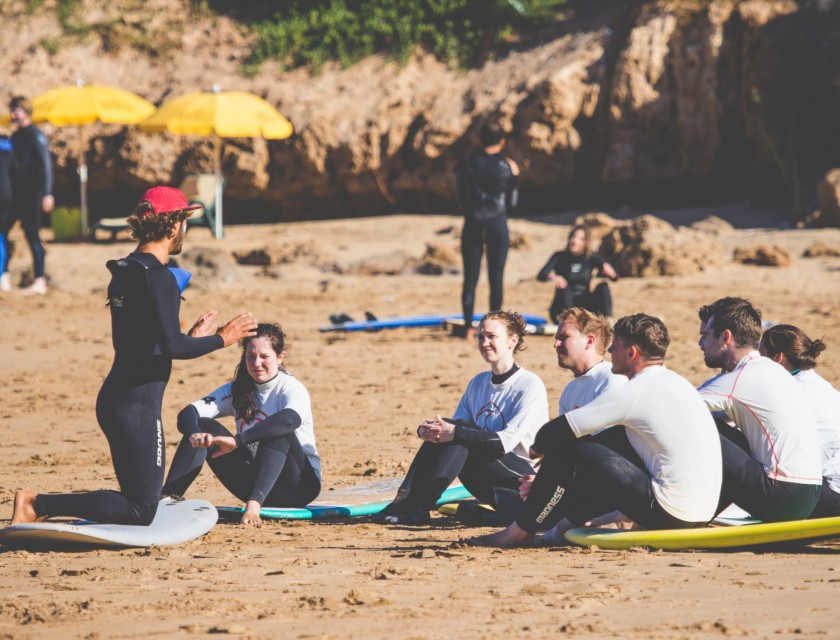
Because when you’re matched to the right group, you catch more waves and get better feedback. Learn why group settings allow you to progress faster.
All in all, we’re big believers in knowing your level so you can surf smarter, not just harder.
The different surfing levels
Complete beginner (Level 1)
- You’re not totally sure which stance you are (regular or goofy)
- Popping up feels like a full-body battle every single time
- You spend more time wiping out than riding
- White water (the foamy stuff close to shore) is your main playground… and that’s perfectly fine
What you need: A big, stable foam board (a mal or a foamie), shallow water, small waves. Probably a lesson or two. Don’t overestimate your abilities. Don’t be embarrassed about starting out either. Everyone starts somewhere! Check out our guide on first-time surfing advice in Morocco.
Beginner (Level 2)
- You can ride a wave to the beach, but negotiating a lineup is… optimistic at best
- You still eat it on a lot of takeoffs
- You still need a big board to catch waves comfortably
- You’re surfing unbroken (green) waves occasionally, but it feels like a happy accident
What you need: More water time. Seriously. Just surf more. Keep the foamie or a longboard and don’t rush to a shorter board. Be patient.
Intermediate (Levels 3 and 4)
Level 3:
- You can take off on unbroken waves consistently
- You’re doing basic turns… not pretty, but functional
- You can paddle out the back at a beach break in moderate surf
- You’re starting to position yourself in the lineup rather than just hoping for the best
Level 4:
- You’re linking turns and generating your own speed
- You’re comfortable duck diving and reading sets
- You can handle head-high waves at a beach break without feeling out of your depth
- You might be starting to dabble at mellower point breaks or reef breaks
What you need: Again, don’t rush to a shortboard if you’re not ready. Work on the fundamentals and start thinking about style. Bottom turns. More advanced waves. Performance shapes. Level 3 guests stay in coached groups at Surf Maroc. Level 4 surfers can move into surf guiding.
Advanced (Levels 5 and 6)
Level 5:
- You’re consistently linking turns with purpose
- You can surf reef and point breaks in small to medium swell
- You’re generating speed and starting to do real manoeuvres (Cutbacks, snaps, floaters)
- You understand surf etiquette
Level 6:
- You’re comfortable in most conditions and actively seeking out bigger, more powerful waves (aka tubes)
- You’re surfing the kinds of breaks most people watch from the beach
- Performance surfing is what it’s all about!
What you need: Now it’s all about refinement and getting out of your comfort zone. New breaks, bigger surf, different types of waves. Morocco’s got plenty to offer here. Spots like Anchor Point and Killer Point are serious waves that reward surfers who’ve put in the hours.
Expert/pro
What are you doing here? You don’t need this article!
The truth about self-assessment
Before you hit us up about your surfing level, remember this: most people rate themselves based on how long they’ve been surfing, not how well they actually surf.
It might hurt to hear, but time in the water doesn’t always equal proficiency.
Someone who surfs twice a week with intention and some coaching will progress faster than someone who paddles out aimlessly every day for years.
When in doubt, drop down a level.
You’ll have more fun, catch more waves and ultimately progress faster.
FAQ
I’ve been surfing for three years. Does that make me intermediate?
Not automatically, no. It really comes down to how well you surf.
Can I go from beginner to intermediate quickly?
For sure! Just know that trying to rush your progress by grabbing a shortboard too early is one of the most common ways people blow it.
What board should I be riding at each level?
Beginners stick to foamies. Intermediates can dabble with a mid-length or funboard… maybe a shortboard once your turns are solid. Advanced. Do your thing.
Is it embarrassing to be a beginner as an adult?
Absolutely not. Some of the most stoked people in the water are adults learning to surf for the first time. Nobody who loves surfing looks down on someone giving it a go.
What if I’m between levels?
Then you’re between levels. We’ll match you with the level most suited to your skills based on our coaches’ feedback. You can always move up or down. No worries.
Why does Surf Maroc use six levels instead of the usual three?
Because “beginner, intermediate, advanced” is too broad to be useful. It’s one of the things that actually makes a difference when you’re trying to improve.
The final say
Your surf level isn’t a fixed thing. It’s not something to be embarrassed about either. It’s just a useful tool for making better decisions in the water.
We use them to maximise your experience with us. And you can rest assured that they’ll help you surf smarter and safer and have more fun!